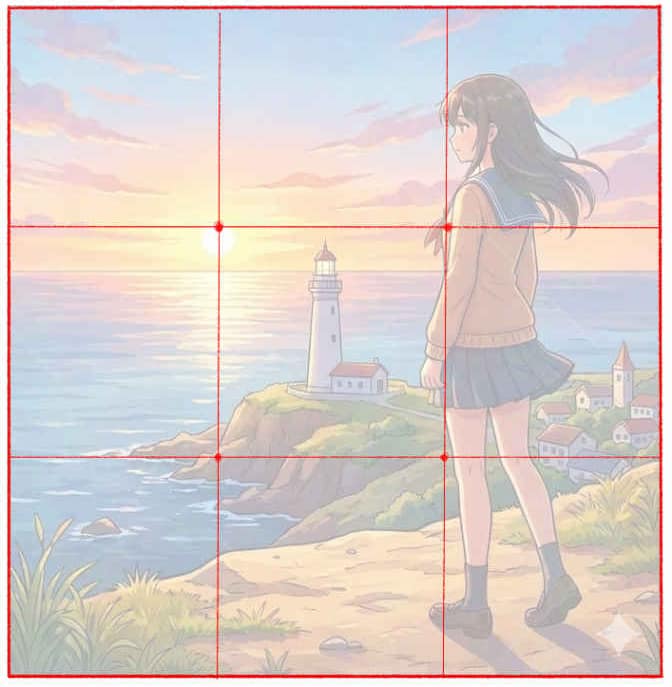
- “I spent a lot of time drawing it, but somehow it doesn’t leave an impression.”
- 🎯 The Impression of an Illustration Is Decided by Placement
- Rule of Thirds: A Beginner-Friendly Composition That “Just Works”
- Railman Composition: Shifting Placement to Create Impact
- A Simple Comparison of the Two Composition Methods
- ✏️ How Composition Changes the Way You Start Drawing
“I spent a lot of time drawing it, but somehow it doesn’t leave an impression.”
“I can draw the character, but the whole illustration feels weak.”
If you draw illustrations, have you ever felt this way?
In most cases, the cause isn’t your drawing skill or sense of style.
It’s actually how you place things on the canvas.
Artists who improve quickly or work professionally decide where to place what before they even start drawing lines—often without realizing it.
Two common composition rules they rely on are the Rule of Thirds and the Railman Composition.
The names may sound complicated, but the ideas themselves are very simple.
In this article, we’ll explain the differences between these two composition rules and how to use them in illustration—even if you’ve never studied composition before.
🎯 The Impression of an Illustration Is Decided by Placement
Whether an illustration looks appealing or not isn’t determined solely by how well you draw characters or how detailed the background is.
What really matters is:
- Where the main subject is placed
Organizing this is what composition is all about.
Let’s start with the most basic and beginner-friendly approach.
Rule of Thirds: A Beginner-Friendly Composition That “Just Works”
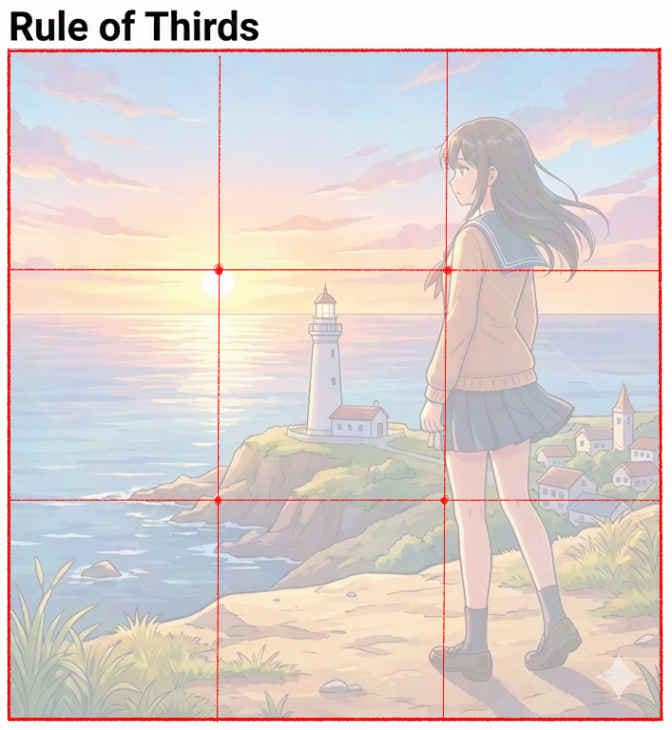
The Rule of Thirds is a way of thinking about composition by dividing the canvas into three equal sections vertically and horizontally.
This creates a 3×3 grid, and you place the main subject near the lines or their intersections.
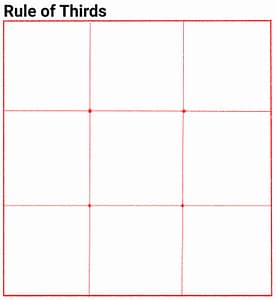
Why the Rule of Thirds Feels So Balanced
Because the subject is placed slightly off-center, the viewer’s eyes are naturally drawn to it.
As a result, the Rule of Thirds helps create:
- A composition that doesn’t feel cramped
- A clearly defined main subject
- A balanced overall image
When to Use the Rule of Thirds in Illustration
- Single-character illustrations or full-body character art
- Simple scenes with backgrounds
- Thumbnails or illustrations for social media
If you’re not sure where to place your subject, starting with the Rule of Thirds will rarely lead you far wrong.
Railman Composition: Shifting Placement to Create Impact
The Railman Composition uses a different approach.
It divides the canvas into four equal sections and adds two diagonal lines, focusing on the points where these lines intersect as visual centers.
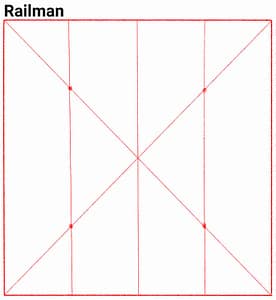
By placing the main or secondary subject near these intersections, you can create a stronger impression than with the Rule of Thirds.
Characteristics of the Railman Composition
- Illustrations that convey emotion or atmosphere
- A single scene with a strong sense of story
- Visuals that focus on mood rather than detail
In these situations, the Railman Composition is especially effective.
It’s less stable than placing a subject in the center and bolder than the Rule of Thirds.
That’s why it tends to stay in the viewer’s memory.
When Railman Composition Works Well
- Character illustrations that emphasize emotion
- Story-driven scenes
- Atmosphere-focused visuals
When you want to make a character stand out, the Railman Composition is especially effective.
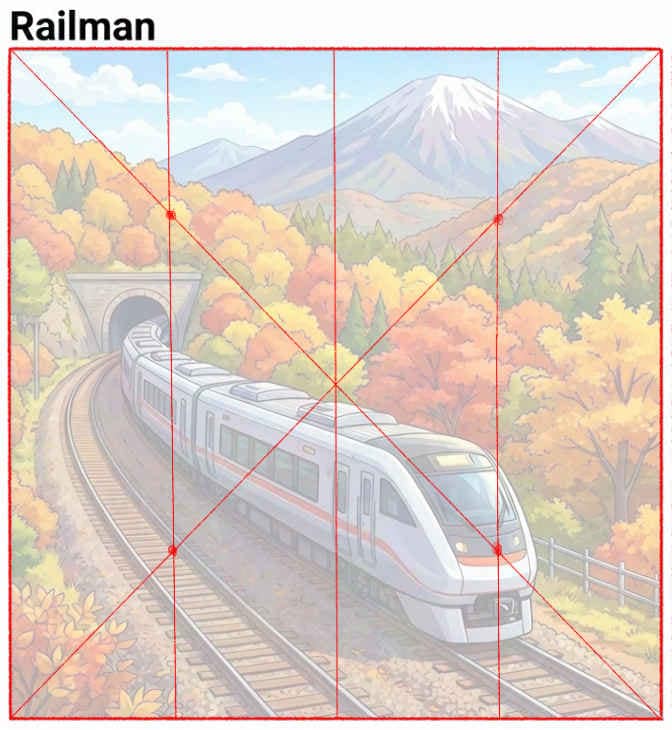
A Simple Comparison of the Two Composition Methods
Rule of Thirds
→ Stable, easy to read, beginner-friendly
Railman Composition
→ Emphasis, tension, memorable impact
In illustration, it helps to think in this order:
“First make it balanced, then make it expressive.”
✏️ How Composition Changes the Way You Start Drawing
Once you understand composition, you’ll be able to:
- Decide the position of the main subject during the rough sketch stage
- Think of negative space as part of the design
- Naturally guide the viewer’s eyes to the parts you want them to see
As a result, you’ll be able to build stronger, more intentional illustration
The Rule of Thirds and the Railman Composition are two great entry points into learning composition.
If you want to move beyond drawing “by feel” and take a step forward, try applying these ideas in your next illustration.
Even with the same drawing skills, the way your work is perceived will change.
Related Articles
Recommended for You
More Articles You May Like ↓ ↓ ↓